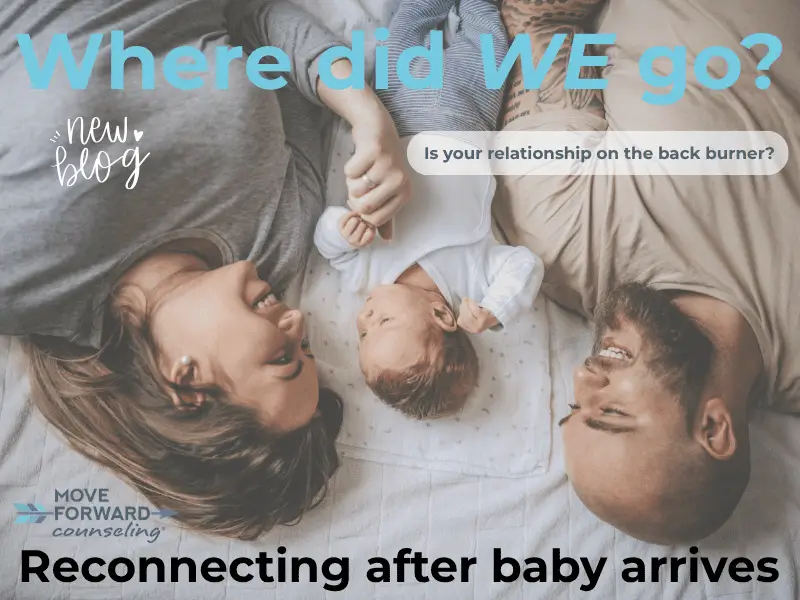
Where Did We Go? Reconnecting After Baby Arrives is a blog that was written by a Move Forward Counseling administrative staff member and reviewed by company leadership.
Does your relationship feel like it’s on the back burner?
You’re exhausted. Your baby’s needs are loud and immediate. Your relationship’s needs are quiet and easy to postpone in comparison. Many new parents don’t choose to deprioritize their marriage or relationship — it just happens by default, due to exhaustion and the extra mental load of maintaining it all.
Exhaustion doesn’t just limit your time together. It can limit your patience, humor, and the energy to have meaningful conversations (that aren’t just about the baby!). “We’ll reconnect when things calm down” can often turn into weeks or even months without realizing how long it’s actually been since you’ve spent time alone together. Many new parents won’t even realize how far apart they’ve grown from their partner until conflict arises.
Planning the days around feeding schedules, nap schedules, chores, and doctor’s appointments can make your relationship feel more like a business partnership than a romantic one. But that does not mean the relationship is beyond repair. Acknowledging the shift in your dynamic can be the first step in working on it together.
Is it normal to feel like strangers after having a baby?
Of course it’s normal to feel like you don’t know your partner anymore. It’s more common than most folks realize, but one of the least talked about challenges after welcoming a baby. Newborns are very demanding and need around-the-clock care. Constant caregiving can overshadow the moments that used to build connection. It can zap energy for inside jokes, casual conversation, and even just checking in.
Sleep deprivation plays a big role as well. When we don’t get enough sleep, it can impact how we respond to situations. We might have a shorter or “snappy” response when we mean to answer calmly. Our patience is gone. We’re more likely to misunderstand our significant other’s tone.
It is possible to be physically close but not emotionally close. It can feel like you or your partner have grown into completely new people. The version of your partner pre-baby didn’t disappear — it could be buried under new roles and responsibilities. Feeling like strangers does not mean the relationship is doomed. It means that both people are stretched thin and need to find a way back to each other.
What happened to date night — and does it matter?
Unfortunately, after welcoming a new family member, date night is often the first thing to go. Not because it’s not wanted, but because there’s no capacity for it. Finding the energy, childcare, and effort to plan date nights can feel like another task on the to-do list. Many couples stop attempting to plan dates, assuming they’ll start to happen “naturally” again later.
The absence of date nights is less about missing out on dinners and more about losing dedicated, meaningful time with your partner. It’s easy for couples to think they’re fine without date nights — after all, you’re together all day anyway. But spending all day parenting is much different than spending undistracted time with your partner.
The question shouldn’t be, “When will we go out again?” Instead, it should be, “How can we make sure we’re still choosing each other?”
Can love and resentment co-exist?
Admitting that you have feelings of resentment toward your partner — while still loving them — can feel quite uncomfortable. It feels like the two should conflict with each other. So how is it possible to feel both?
Resentment can build up quickly and quietly. It can start with small imbalances.
- Who woke up more overnight with the baby?
- Who gets to shower more?
- Who remembers all of the pediatrician appointments?
- Who gets more downtime?
It doesn’t always mean something is wrong in the relationship. It can be a response to an unsustainable load. If the resentment never gets addressed, it will continue to grow. But if you acknowledge the (totally valid) feelings you’re having, it tends to shrink.
Many couples think that admitting they have feelings of resentment also means admitting to failure. In reality, recognizing those feelings gives you information about what needs to change.
The goal is not to eliminate resentment entirely. The goal is to prevent it from being the loudest voice in the room.
How do you find each other again after the baby fog lifts?
Reconnection doesn’t typically happen all on its own — at least one partner will need to make an intentional first step. Finding each other again doesn’t mean things will go back to the way they once were. It means working together to find your new normal after your baby arrives.
Small gestures can be a great first step toward reconnecting: a quick text during the day, noticing and doing a task that needs to be done (without being asked), or even brewing your significant other’s coffee. Physical closeness can help too, not just intimacy — a hand on their back, sitting next to each other, or a warm embrace after work can rebuild the sense of familiarity.
Couples with children might also need to make a conscious effort to spend time together, even if it’s a few small five- to ten-minute increments, a quick conversation, or watching a show together. Planning a date night once every few weeks can help, too. Opportunities for one-on-one time with your partner don’t come up as often or as naturally with children, so setting time aside specifically can help wonders.
Finding each other again does not mean going back to the way things once were. Instead, it’s creating a new normal during the chaos. Don’t make assumptions about your partner — be curious and get to know who they are now.
Is this a phase, or a sign that something needs attention?
It’s normal to expect some relationship strain after a new baby. This is often temporary but doesn’t always resolve on its own. The difference between a phase and something more serious is progression.
Are things slowly getting better over time, or are they steadily going downhill? Here are a few key factors to be aware of:
- Persistent disconnection
- Ongoing resentment
- Avoiding each other
- Picking fights over things that might not have been a big deal in the past
Waiting for things to “naturally” get better can allow patterns to become entrenched. Acknowledging that there are serious issues in the relationship does not mean it’s broken or beyond repair. It’s beneficial to address them early, as soon as you notice them.
So, where do you go from here?
Welcoming a new baby doesn’t just change the relationship — it changes both individuals within it, often at the same time. Individual counseling can help each partner process their new identity shift without putting that weight on the relationship. Couples counseling creates a space to rebuild communication, address resentment, and reconnect with structure and support. You don’t need to wait for things to get better on their own.
Struggling after a baby doesn’t mean something is wrong with the relationship. It means you need support after a major life change. Asking for help does not have to be the last resort. Getting the help you and your relationship need is one of the most proactive things you can do as a new parent.
Couples Counseling versus Individual Therapy
At Move Forward Counseling, licensed Pennsylvania therapists use blended approaches tailored to your needs. Move Forward Counseling offers in-person therapy at several locations and online therapy for individuals across Pennsylvania. If you seek counseling for you and your spouse or partner together, our partner practice, Heartwell Therapy, LLC, offers relationship, couples, and family counseling online across PA and in person in York and Lancaster, PA.
What to Expect at Move Forward Counseling or Heartwell Therapy
- A warm, grounded first session
- Space to share your story at a comfortable pace
- Help identifying whether individual counseling, couples counseling, or both are the best fit
- Insurance-friendly options and online sessions across Pennsylvania
Mini-FAQ
Do you offer online therapy? Yes—online therapy is available statewide.
Can my partner and I see different therapists? Yes—many couples benefit from pairing individual sessions with couples counseling.
Is the first session overwhelming? Most people find it grounding and calming.
Do you offer flexible scheduling options? Yes—availability varies by therapist.
How to Get Started
If you’re unsure where to begin, reaching out to learn more can be a helpful first step. Remember, the first session is a chance to feel supported, talk through what’s changed, and explore what’s possible with someone trained to help couples and new parents navigate this season.
Move Forward Counseling and Heartwell Therapy are here to help you take that next step at a pace that feels comfortable and reassuring. Contact MFC or HWT to get started. Heartwell Therapy offers a free 15-minute consultation so you can meet the therapist before committing to your first couples session.