The Empty Chair During the Holiday Season was written by a mental health therapy blog writer hired by MFC to develop wellness articles. MFC leadership reviewed this article for clinical quality and accuracy.
The Empty Chair During the Holiday Season
Navigating Grief and The First Holiday Without Them
Daylight saving time ushers in shorter, darker days, festive lights, and holiday cheer. This time of year is marked with anticipation, celebration, and connection for some, and overwhelming loneliness and profound difficulty for others.
A national survey by Experience Camps revealed that 36% of Americans do not feel like celebrating the holidays due to a sense of grief and loss. Additional data from the American Psychological Association (APA) shows that while 88% of adults feel the weight of holiday stress, 38% report that their stress was caused by the emotional toll of missing family and loved ones during the holidays.
Understanding Grief
The APA defines grief as the anguish experienced after a significant loss. While grief is usually associated with the death of a loved one, loss can take many forms. It can stem from life changes, such as divorce, the loss of a job, a chronic health diagnosis, or a major life transition.
In some cases, grief can also happen before loss happens. Anticipatory grief occurs before an expected significant loss, such as when a loved one is battling a terminal illness, or when someone is caring for an aging, seriously ill pet. Anticipating a goodbye while the world around you is celebrating can create a unique, exhausting emotional weight.
As you navigate these complex feelings, it is also helpful to release some of the common societal myths surrounding grief. Grief does not follow a neat, predictable sequence, and there is no universal timeline that dictates when mourning should “end.”
I Was OK until the Holiday Season: Why the Holidays Amplify Grief
The holiday season in the US begins in November and goes on into the New Year. This period is built around themes of family, favorite songs, nostalgic movies, and shared celebrations. Because these traditions are so deeply ingrained into the season, absence is magnified.
Several factors make this season particularly challenging for those who are grieving, whether through bereavement, divorce, or major life shifts:
- Sensory Triggers: Familiar sights, sounds, and smells, the scent of pine, holiday music playing in stores, or a specific family recipe, can instantly bring a wave of raw emotion, making the void left by a loved one impossible to ignore.
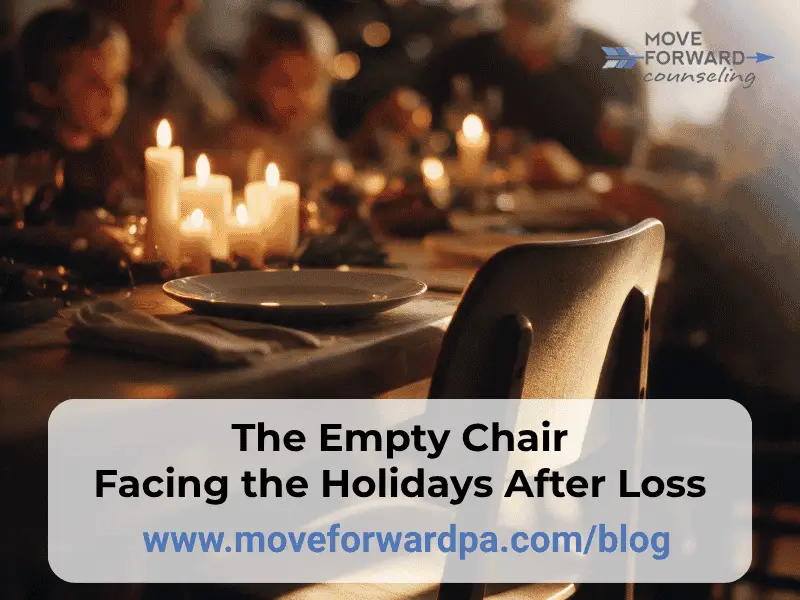
- The “Empty Chair” Reality: Sitting down to a holiday meal or gathering with an empty seat at the table highlights the physical absence of someone who used to be there.
- Conflicting Grieving Styles Within Families: During family gatherings, you may encounter mismatched coping styles such as one person who wants to talk constantly about the missing loved one to keep their memory alive, and another who avoids mentioning them entirely because it hurts too much. This friction can add unexpected stress to an already fragile environment.
- Loss of Extended Family and Shared Circles: Beyond the absence of a partner or loved one, losses like divorce often bring a ripple effect of secondary losses. Navigating the absence of former in-laws, changing family dynamics, or feeling awkward entering shared social circles alone can heighten feelings of isolation.
- Loss of Traditions and Milestone Anticipation: Whether it’s your first holiday without them or another difficult milestone, the disruption of old traditions can feel disorienting. You may also find yourself hyper-aware of how things ended, replaying painful memories.
- Forced Social Energy and Societal Pressure: Society pushes a heavy narrative of mandatory joy, gratitude, and cheer during the holidays. This forced social energy can be exhausting. Furthermore, while grief from death is universally recognized, losses like divorce can sometimes be met with uncomfortable silence or unhelpful comments, leaving you feeling pressured to act fine before you are ready.
Facing the First Holiday Without Them
The first holiday without them is one of all the milestones in the grieving process. Whether it’s your first Thanksgiving, Hanukkah, Christmas, or New Year’s missing a parent, partner, sibling, or friend, the first year makes the loss real through:
- The Shock of the “Firsts”: During the initial months of loss, you are often still in a state of shock or survival mode. When the holidays arrive, they act as a harsh calendar marker reminding you that time is moving forward, even when your world has stopped.
- Navigating Custody and Empty Homes: For parents going through a divorce or separation, the first holiday often means navigating a co-op or split-custody schedule for the first time, facing a holiday morning with a quiet, empty house while your children are celebrating elsewhere.
- The Anticipatory Dread: Often, the anxiety of imagining the first holiday is even heavier than the day itself. Your brain tries to predict how painful the empty seat or missing voice will be, leading to weeks of pre-holiday dread.
- The Illusion That Everyone Else Is Fine: Looking out at a world full of bustling shoppers and cheerful gatherings can make your internal isolation feel absolute. It can feel jarring that the rest of the world has kept spinning while your personal universe has fundamentally shifted.
How do you Recognize Holiday Grief?
Grief can manifest physically and emotionally through:
- Physical Exhaustion: Deep fatigue, changes in sleep patterns, or frequent headaches.
- Emotional Numbness or Overload: Feeling completely detached from the festivities, or conversely, feeling easily overwhelmed by minor stressors.
- Anxiety and Dread: Feeling a knot in your stomach at the thought of attending social events or maintaining old traditions.
- Irritability and Anger: Frustration with the commercialization of the holidays or the cheerful expectations of others.
An Additional Layer: Seasonal Affective Disorder (SAD)
When looking at winter grief, it is also essential to watch out for additional factors like Seasonal Affective Disorder (SAD). SAD is a type of depression that comes and goes with the seasons, typically starting in late autumn and lasting through the winter months. The combination of shorter daylight hours, colder weather, and reduced sunlight can significantly impact your mental health. When SAD intersects with grief, the physical fatigue, low mood, and lack of motivation can compound exponentially, making self-care even more crucial.
How to Cope with Grief During the Holiday Season
You don’t have to force yourself to feel joyful just because the calendar says so. Coping with grief, especially during those monumental “firsts”, is about self-compassion and carving out space for your authentic experience:
- Give Yourself Permission to Feel: Acknowledge your emotions without judgment. It is okay to feel sad, angry, relieved, or numb, or even to experience moments of happiness interspersed with grief.
- Redefine or Release Traditions: You don’t have to do things the way you’ve always done them. If a traditional gathering feels too heavy, give yourself permission to skip it, modify it, or create a brand-new, low-pressure tradition that honors your current capacity.
- Honor Their Memory and Practice Gentle Gratitude: Find meaningful, low-stress ways to incorporate your loved one or what you’ve lost into the season. You can light a candle in their honor, sharing a favorite memory with someone who understands, or practice a quiet moment of gratitude for the time you shared.
- Set Boundaries: It is entirely okay to say “no” to holiday parties, large crowds, or conversations that drain your energy.
- Look for Gentle Moments of Joy: Trying to force happiness rarely works. Instead, look for micro-moments of comfort like a warm cup of tea, a quiet walk, or watching a comforting show.
How to Support Someone Going Through Their First Holiday
If you have a friend, family member, or colleague navigating their first holiday season after a bereavement or a divorce, you might feel unsure of how to show up for them. Meaningful support doesn’t require fixing their pain but rather holding space:
- Avoid Clichés and Toxic Positivity: Skip phrases like “time heals all wounds” or “everything happens for a reason.” Instead, acknowledge their reality directly: “I know how hard this holiday must be for you, and I’m thinking of you.”
- Extend Invitations with an Easy Out: Invite them to dinner or a holiday gathering but explicitly remove the pressure: “We would love to have you join us, but there is zero pressure. If you want to drop by for ten minutes or stay home completely, I completely understand.”
- Check In Without Demanding a Response: Send a text letting them know you care and add a safety valve: “No need to reply to this text.” This shields them from the emotional labor of managing other people’s comfort when they are already depleted.
- Validate the Specificity of Their Loss: Whether they are mourning a death, navigating a painful divorce, or dealing with split holiday custody, acknowledge that their grief is complex, valid, and entirely deserving of grace.
How Therapy Can Help You Cope with Holiday Grief
Navigating grief, especially when amplified by the holidays and seasonal changes, can be heavy to carry alone. Therapy provides a safe, non-judgmental space to process complex emotions, unpack difficult memories, and navigate complicated family dynamics or expectations.
A therapist can help you build personalized coping strategies, validate your experience, and guide you toward a gentler relationship with your grief as you move through the season. If the weight of the holidays feels too heavy to bear, reaching out for professional support is a courageous first step.
How to Start Grief Counseling in Pennsylvania
A grief counselor can provide a supportive, nonjudgmental space to process difficult emotions, explore healthy coping strategies, and begin adjusting to life after a significant loss.
Move Forward Counseling offers online grief therapy across Pennsylvania, as well as in-person counseling at our locations in Lancaster, Lebanon, Pittsburgh, Hershey, State College, and York. Our therapists support individuals experiencing bereavement, relationship loss, job loss, relocation, and other significant life transitions. Contact us to get started or for help scheduling and matching with an MFC grief-specialized licensed counselor. Our scheduling team is here to help you find the right therapist for your needs.